



Go to Invoices → Settings → WooCommerce → General to configure order numbering, the sale date, free orders and items, and additional information displayed on documents. Click Save changes after editing the settings.
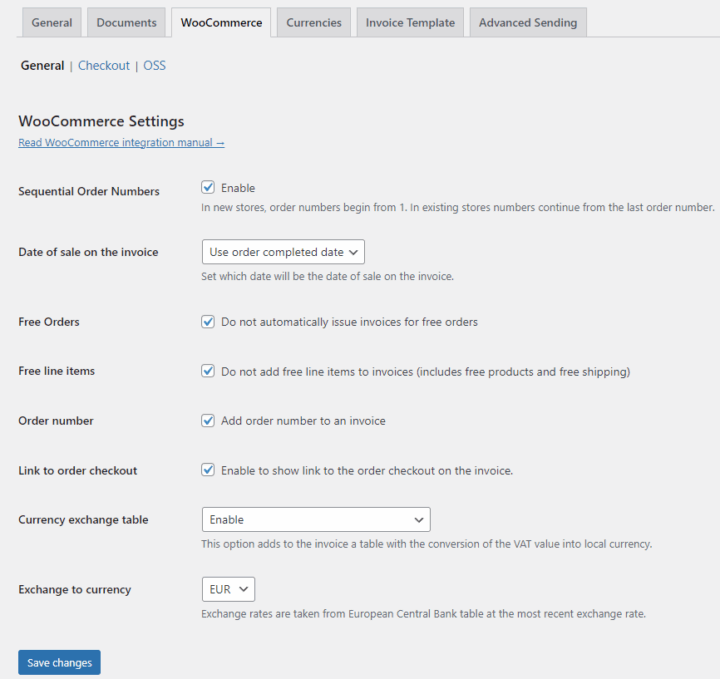
If (Beta) Gutenberg Invoice Editor is enabled in Invoices → Settings → Invoice Template, the Order number, Link to order checkout, and Currency exchange table settings are hidden. Add the corresponding blocks to the active template instead. Exchange to currency remains in the WooCommerce settings.
Sequential Order Numbers#
Enable this option to assign sequential numbers to WooCommerce orders. In a new store, the sequence starts at 1. In a store with existing orders, numbering continues from the existing order numbering.
This controls order numbers. Configure invoice numbering separately in Invoices → Settings → Documents → Invoice, or in the active template's settings when using the Gutenberg invoice editor.
Date of sale on the invoice#
Choose the source of the sale date for documents created from WooCommerce orders:
- Use order date – use the date the order was created.
- Use order completed date – use the completion date recorded for the order. If the order does not yet have a completion date, the plugin uses its creation date.
This setting chooses the date value. To change the wording displayed beside the date, use Label for Date of Sale in the invoice settings, or edit the text in the Gutenberg template.
Free Orders#
Enable Do not automatically issue invoices for free orders to exclude orders with a zero total from automatic document issuing.
This setting controls automatic issuing. It does not prevent you from issuing a document manually.
Free line items#
Enable Do not add free line items to invoices (includes free products and free shipping) to omit items with a zero net price when the plugin builds a document from an order.
This can exclude free products and free shipping. It does not remove items from the WooCommerce order. Use Free Orders separately if you also want to skip automatic issuing for an entire zero-total order.
Order number#
Enable Order number to display the related WooCommerce order number on the invoice when using classic templates.
With the Gutenberg invoice editor enabled, add an Order number block to the active template instead.
Link to order checkout (PRO)#
Enable Link to order checkout to add a Pay for this order link to documents linked to a WooCommerce order.
In classic templates, the link appears when the document is not marked as paid and the order status is Pending payment, On hold, or Failed. WooCommerce determines whether payment is available when the customer opens the link.
With the Gutenberg invoice editor enabled, add a Payment link block instead. The block is hidden when the linked order is paid or cannot be found; it does not use the classic template's status list.
Currency exchange table (PRO)#
Use this setting to add a supplementary table showing converted tax, net, and gross amounts grouped by tax rate. The table includes exchange rate information and uses rates obtained from the European Central Bank.
For classic templates, choose:
- Disable – do not add the conversion table.
- Enable – enable the table without requiring a nonzero document tax total.
- Enable only if tax value is higher than 0 – display the table only when the document has a nonzero tax total.
The table is displayed only when conversion data and eligible items are available. Selecting Enable does not guarantee a table on every document, for example when the document and target currencies are the same.
With the Gutenberg invoice editor enabled, add a Table of conversion block to the active template. The classic table visibility selector does not control this block.
Exchange to currency (PRO)#
Select the target currency for the conversion table, for example PLN or EUR. This setting applies to the classic conversion table and the Gutenberg Table of conversion block.
This adds converted values to the document; it does not change the order currency, the invoice's main currency, or the amount charged to the customer.
Conversion requires exchange rate data for the source and target currencies. The plugin saves conversion data with the document, so changing the target currency is not a way to recalculate all existing invoices.