




Reverse charge means a business customer in another EU country settles the VAT themselves, so your invoice shows no VAT and carries a reverse charge note instead. Two conditions have to hold: the buyer is in a different EU country than your store, and their VAT number validates against VIES. WooCommerce handles the rate table but has nothing for the validation or the note, so both come from a plugin. The setup is three settings in Invoices → Settings → WooCommerce → OSS: switch on VIES validation, decide what happens when a number fails, and point the plugin at the same tax class your products use. This guide covers all three and what to check once it is running.
- Who pays the VAT on an EU sale
- VAT rates in WooCommerce for consumer orders
- VAT for EU company orders
- How to set up reverse charge
- What to check afterwards
- Frequently asked questions
Who pays the VAT on an EU sale
Four situations, and the store has to tell them apart before it can charge correctly.
| Buyer | VAT on the order | Note on the invoice |
|---|---|---|
| Consumer in your country | Your country’s rate | None |
| Consumer in another EU country | Your rate under the EUR 10,000 threshold, the customer’s rate above it | None |
| Company in your country | Your country’s rate, as normal | None |
| Company in another EU country, valid VAT number | None | Reverse charge |
The last row is the one that needs automating, and the third row is the one people get wrong: a domestic business customer pays VAT like anyone else. Reverse charge applies across a border, not to companies in general.
The rules behind this differ by what you sell and where you are established, so your accountant has the final say. What the store has to do is mechanical: identify which row an order falls into and apply the matching treatment.
VAT tax rates in WooCommerce for orders from the EU
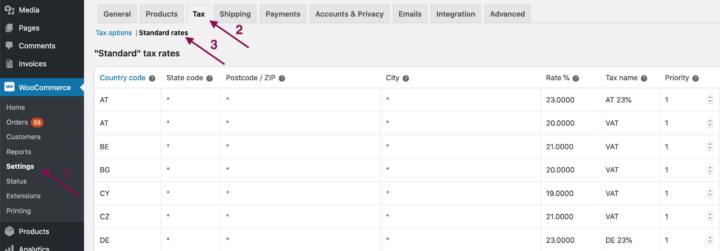
Rate management is built into WooCommerce, in WooCommerce → Settings → Tax. Create a tax class holding the rates for each country you sell to. The example below uses the Standard class:
Then set that class on your products, in Products → the product → the Tax class field:
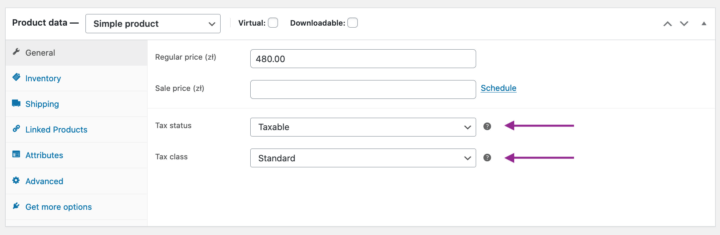
That covers consumer orders. Which class you pick here matters later, because the reverse charge setup has to point at the same one.
You can import VAT rates from a CSV instead of typing them in. See importing VAT tax rates from a CSV file.
For the full tax configuration, see the WooCommerce taxes tutorial.
VAT tax rates in WooCommerce for EU company orders
A business customer in another EU country accounts for the VAT in their own country, which means your order must go out without VAT on the product prices and the invoice must say why.
WooCommerce has no built-in tool for any of this. It cannot collect a VAT number at checkout, cannot check whether that number is real, and cannot put a note on a document it does not produce. All three come from a plugin such as Flexible PDF Invoices PRO.
The collection part is worth pausing on. WP Desk telemetry from 19,803 WooCommerce stores, collected in August 2026, shows 86.2% of orders placed as guests. A guest has no account to return to, so a VAT number that was not asked for at checkout was not collected at all, and the order will be treated as a consumer sale.
How to set up the reverse charge invoice in WooCommerce
After installing and activating the plugin, go to Invoices → Settings → WooCommerce → OSS:
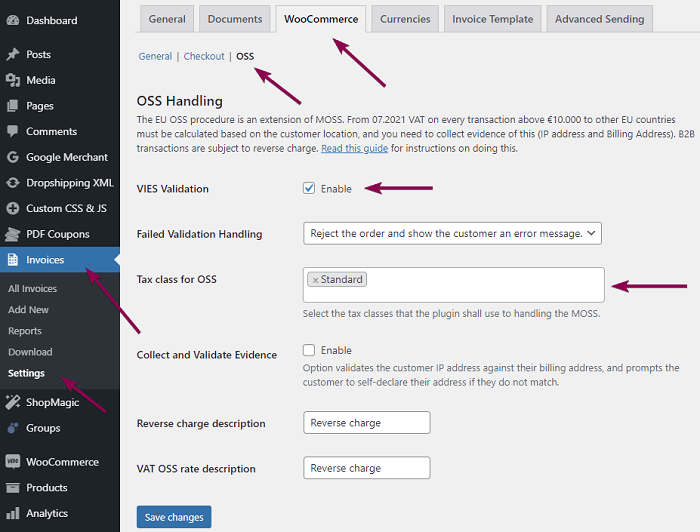
Three settings decide the behaviour.
VIES validation has to be on. It connects to the OSS and reverse charge check and confirms the customer’s VAT number against the European Commission’s database. Without it you are taking the customer’s word for a number that determines whether tax is owed.
Tax Class for OSS must be the same class you set on your products and filled with rates. Pointing it at a different class is the most common misconfiguration here, and the symptom is confusing: validation works, the note appears, and the amounts are wrong.
Failed Validation Handling decides what happens when the number does not check out. Three options, and they are not equal.
| Option | What happens | Risk |
|---|---|---|
| Block the order | The customer cannot complete the purchase | A VIES outage costs you the sale |
| Accept, keep VAT | Order goes through with VAT charged | A legitimate buyer pays VAT and asks for a correction |
| Accept, remove VAT | Order goes through with no VAT | You carry the liability if the number was not valid |
Take the middle one. VIES has scheduled maintenance and individual member states’ databases go offline independently, so a number failing at two in the morning is often a service problem, not a fake number. Charging VAT keeps the sale and keeps the tax position safe, and a genuine business customer can be issued a correction afterwards. Removing VAT on an unvalidated number puts the liability on you, and blocking the order turns every outage into lost revenue.
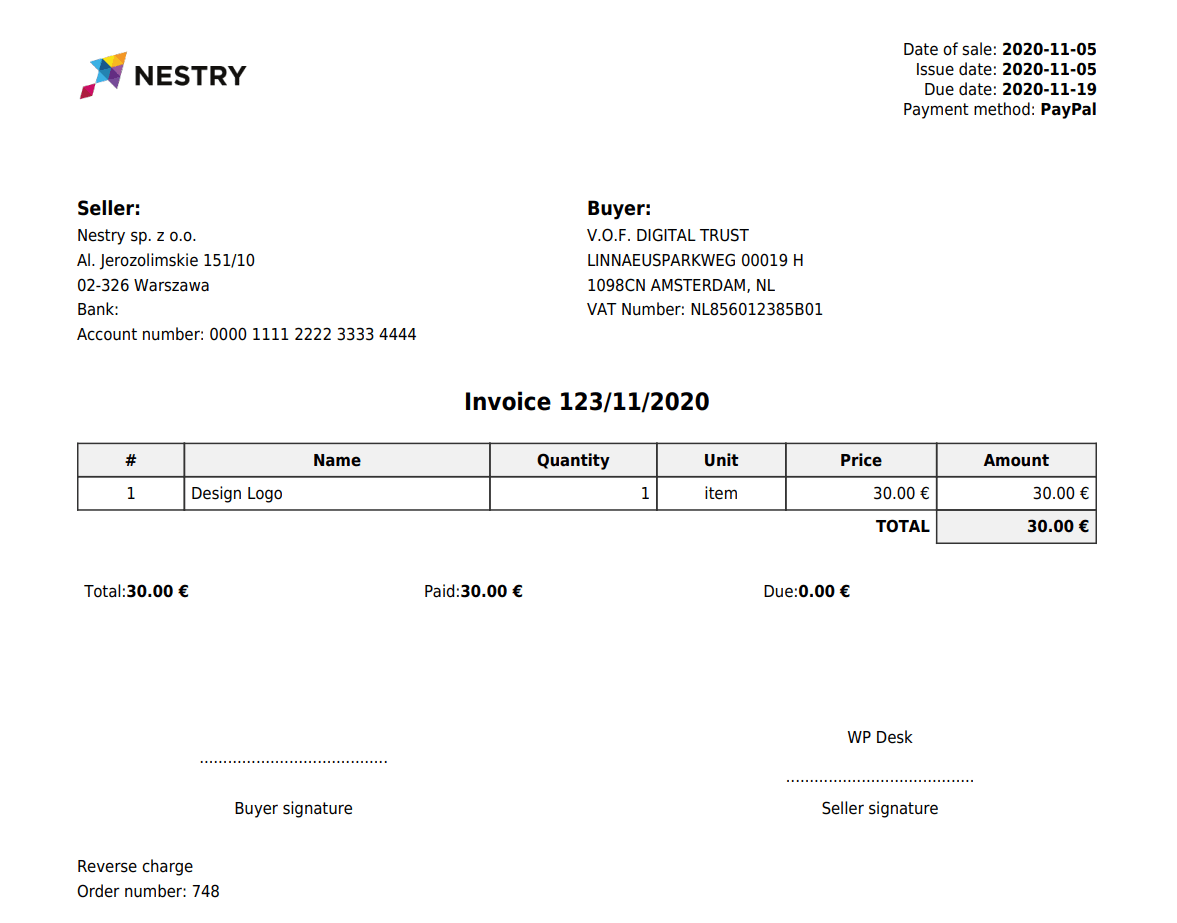
Reverse charge on the invoice
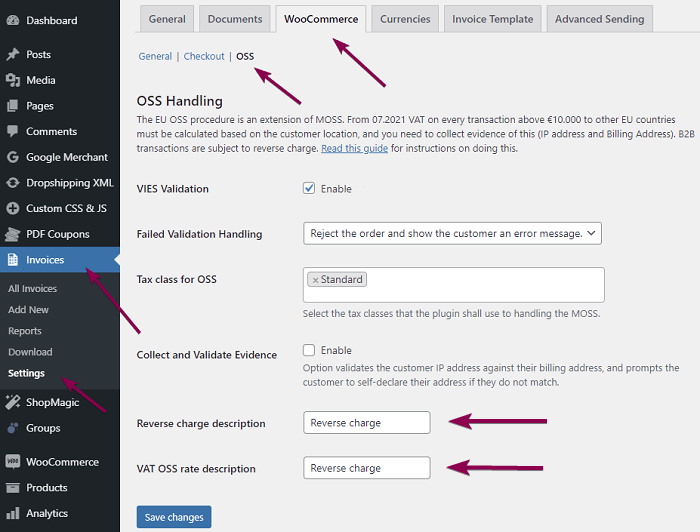
From then on, every invoice issued to a company from another EU country carries the Reverse charge note, alongside both VAT numbers.
What to check afterwards
Place three test orders rather than one, because the configuration only proves itself across the cases it has to tell apart.
A consumer order from another EU country, which should carry VAT at the rate your threshold position requires. A business order from your own country with a VAT number, which should still carry VAT: if this one comes out at zero, the rule has been applied too broadly. And a business order from another EU country with a real, valid VAT number, which should come out at zero with the note on the document.
Then test a deliberately wrong VAT number and confirm the store does what you chose in Failed Validation Handling. That is the branch nobody tests and the one that runs at the worst moment.
Summary
Reverse charge is a narrow rule with a wide blast radius: no VAT, but only for a business buyer in another EU country with a VAT number that actually validates. WooCommerce gives you the rate table and nothing else, so the VAT field, the VIES check and the note on the invoice all come from a plugin. Point the OSS tax class at the same class your products use, set failed validation to accept the order with VAT rather than blocking it or zero-rating it blind, and test all four buyer types before the first real B2B order rather than after it.
Check the settings in a free demo first, or ask us about your case.
Frequently asked questions
What is reverse charge in WooCommerce?
A VAT rule where a business customer in another EU country accounts for the tax themselves. Your invoice shows no VAT and carries a reverse charge note, with both parties’ VAT numbers on the document.
Do I charge VAT to a company in my own country?
Yes, at the normal rate. Reverse charge applies across a border, not to business customers in general. A domestic B2B sale is taxed like any other domestic sale.
Does WooCommerce support reverse charge out of the box?
No. It has no VAT number field at checkout, no VIES validation and no invoices, so all three parts have to come from a plugin.
What is VIES and why does validation depend on it?
VIES is the European Commission’s VAT number checking service, which queries each member state’s own database. Validation is a live lookup, so it can be unavailable for one country while working for others.
What should happen when a VAT number fails validation?
Accept the order and charge VAT. Blocking turns a VIES outage into a lost sale, and removing VAT on an unvalidated number leaves the liability with you. A genuine business customer can be issued a correction afterwards.
Which tax class should I select in the OSS settings?
The same one you assigned to your products and filled with country rates. A mismatch here produces working validation and wrong amounts, which is harder to spot than an outright failure.
Is the VAT number enough to zero-rate an order?
It is the trigger, not the whole condition. The buyer also has to be in a different EU country, and the number has to validate. Your accountant decides what evidence you need to keep for the supply itself.
Can the reverse charge note be added automatically?
Yes. Once validation is on and the tax class is set, the plugin adds the note to every qualifying invoice without anyone checking the order.
