


Core WooCommerce cannot produce a downloadable receipt; the order confirmation email is all it sends. The free Flexible Invoices plugin adds one: fill in your company details, set the document prefix to Receipt, then click Issue Invoice on the order to generate a numbered PDF you can view, download and email. Seven steps, no accounting software involved. One thing to be clear about before you start, because it decides whether this is the right tool at all: changing the prefix changes the document’s name, not its legal character.
Receipt or invoice: what the plugin actually issues
Most countries require a seller to hand the buyer some document proving the purchase, and in plain English that document is usually called a receipt. In tax law the words are often not interchangeable. Several countries treat a fiscal receipt and an invoice as two distinct documents with different rules, and in some of them a fiscal receipt has to come from a registered cash register rather than from software.
What this guide produces is an invoice with Receipt printed on it. For a great many stores that is exactly what is wanted, and it is what customers mean when they ask for a receipt. If your country distinguishes the two in law, check with your accountant which one you are obliged to issue before renaming anything, because the prefix field will not settle that question for you.
Flexible Invoices is free, handles VAT, and lets you customize, brand and deliver the document yourself.
Table of contents
In this article, you’ll read about:
- Standard WooCommerce receipt
- Steps to create WooCommerce receipts
- Automatic WooCommerce receipts
- Frequently asked questions
Standard WooCommerce receipt
On a clean WooCommerce install, the only thing resembling a receipt is the standard transaction email:
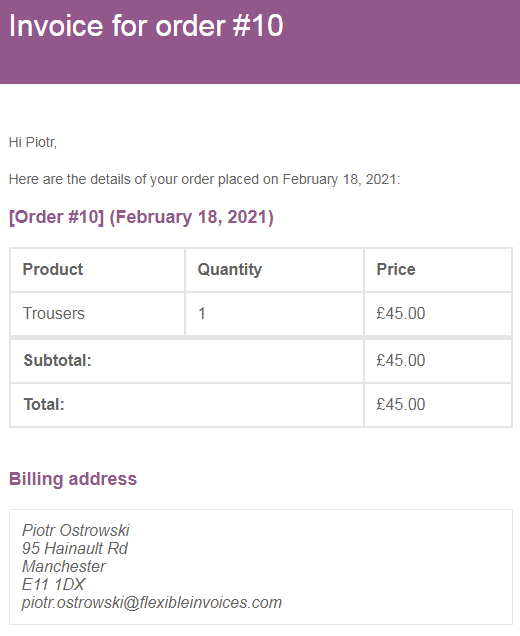
The customer can print it, but it is not a document in any useful sense. It has no document number, no issue date and none of the seller details a buyer needs for their own books, and there is no copy of it stored in the shop, so neither side can produce it again later. A PDF with a number solves all three problems, and a free plugin is enough.
Step 1: install the Flexible Invoices plugin
Go to Plugins, click Add New and search for Flexible Invoices:

Click Activate once the installation finishes.
Step 2: fill in your business details
A new Invoices menu appears in the dashboard. Open its settings and enter your company data:
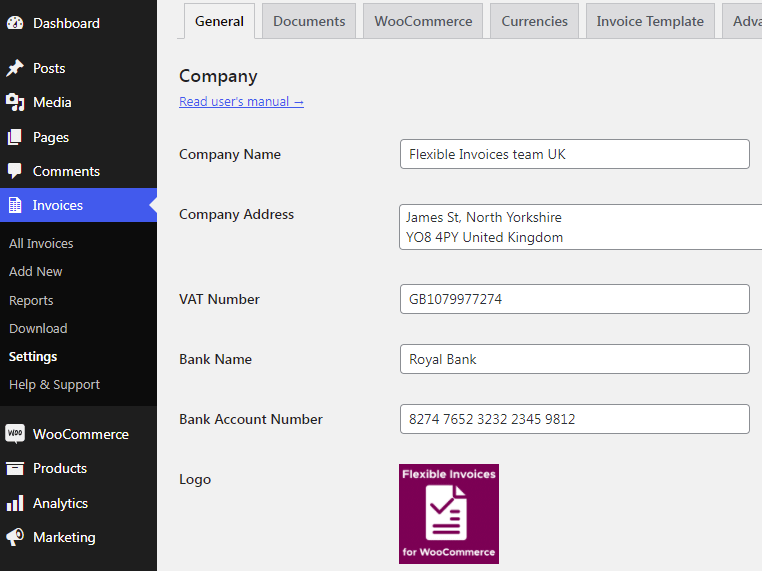
- Company Name: your registered business name
- Company Address: the address of your company
- VAT Number: if you have one
- Bank Name and Bank Account Number: needed if you accept bank transfers
- Logo: pick a file from the Media Library to print on the document
These details are taken from the plugin rather than from WooCommerce, so they appear on every document regardless of what the shop settings say. Get them right once and the rest is automatic.
Step 3: enter Receipt as the prefix
By default the plugin names each document Invoice. To call it a receipt instead, go to the Documents tab and type Receipt as the prefix:
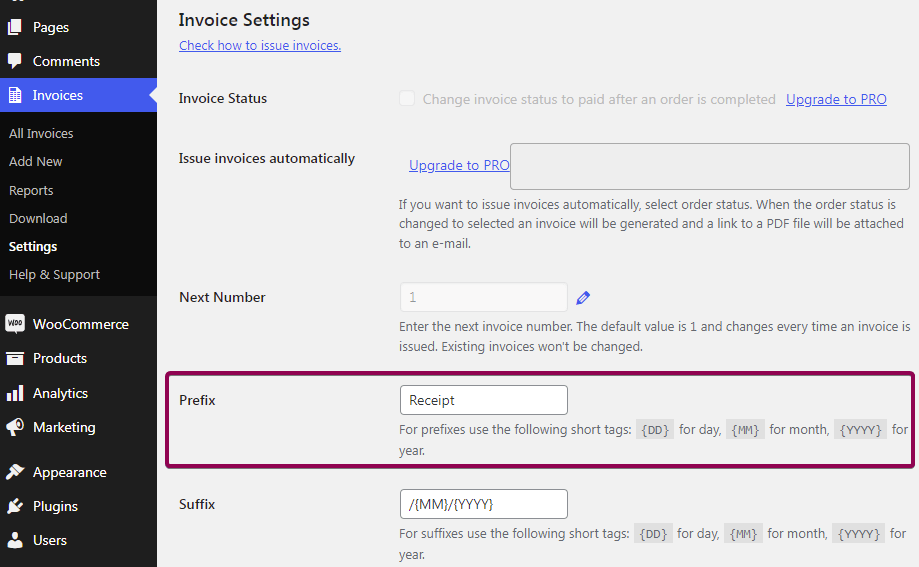
Add a blank space after the prefix so it does not run into the number. The suffix accepts short tags:
- {DD} for day,
- {MM} for month,
- {YYYY} for year
So the finished name has three parts:
- prefix, in this example Receipt
- document number, for example 1
- suffix, here the month and year the document was created
Set the prefix before you issue your first document. The number itself keeps counting regardless of what the prefix says, so changing it later gives you one series of documents named Invoice 1 to Invoice 40 and the next named Receipt 41 onwards. Nothing breaks, but you now have two naming conventions covering one sequence, which is the kind of thing an accountant asks about a year later.
Step 4: generate the WooCommerce receipt
Open the WooCommerce order edit screen. A new metabox appears on the right with an Issue Invoice button:

Clicking it generates the PDF and stores it in the admin panel.
Step 5: view the receipt
Use the View or Download buttons in the Flexible Invoices metabox:

The document is numbered 1 because it is the first one issued in this shop. The next will be 2, then 3, and the sequence continues across orders rather than restarting.
Step 6: save the PDF to your disk
The downloaded file is a finished document you can keep for your own records:
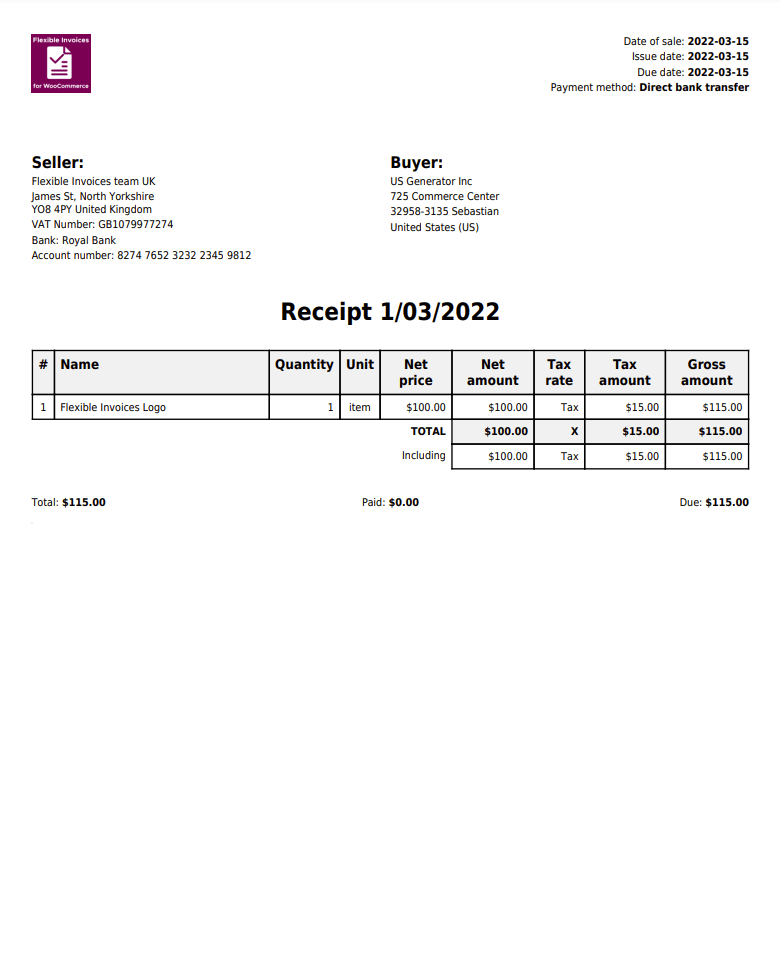
For whole periods rather than single orders, bulk download by date range is the faster route, and it is what an accountant usually asks for at the end of a month.
Step 7: send the PDF receipt to your customer
On the same edit screen there is a Send by e-mail button. Clicking it sends the document to the customer straight away:
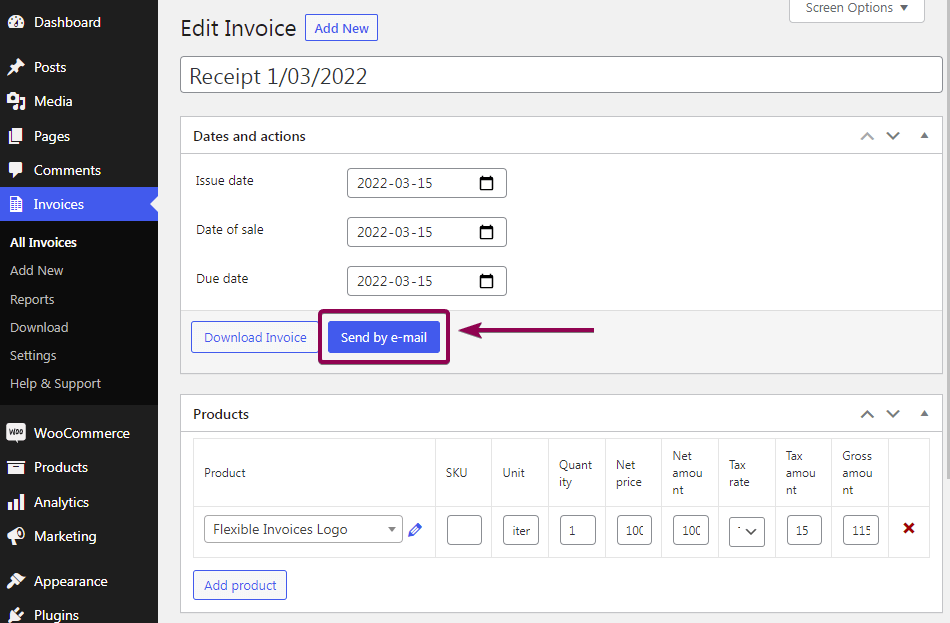
That is the whole manual workflow: two clicks per order, once the settings are in place.
Automatic WooCommerce receipts in the PRO version
Two clicks per order is fine at five orders a week and tedious at fifty. The PRO version issues and sends the document on its own.
Choose the order statuses that should trigger it, and every matching order is handled without anyone opening it:
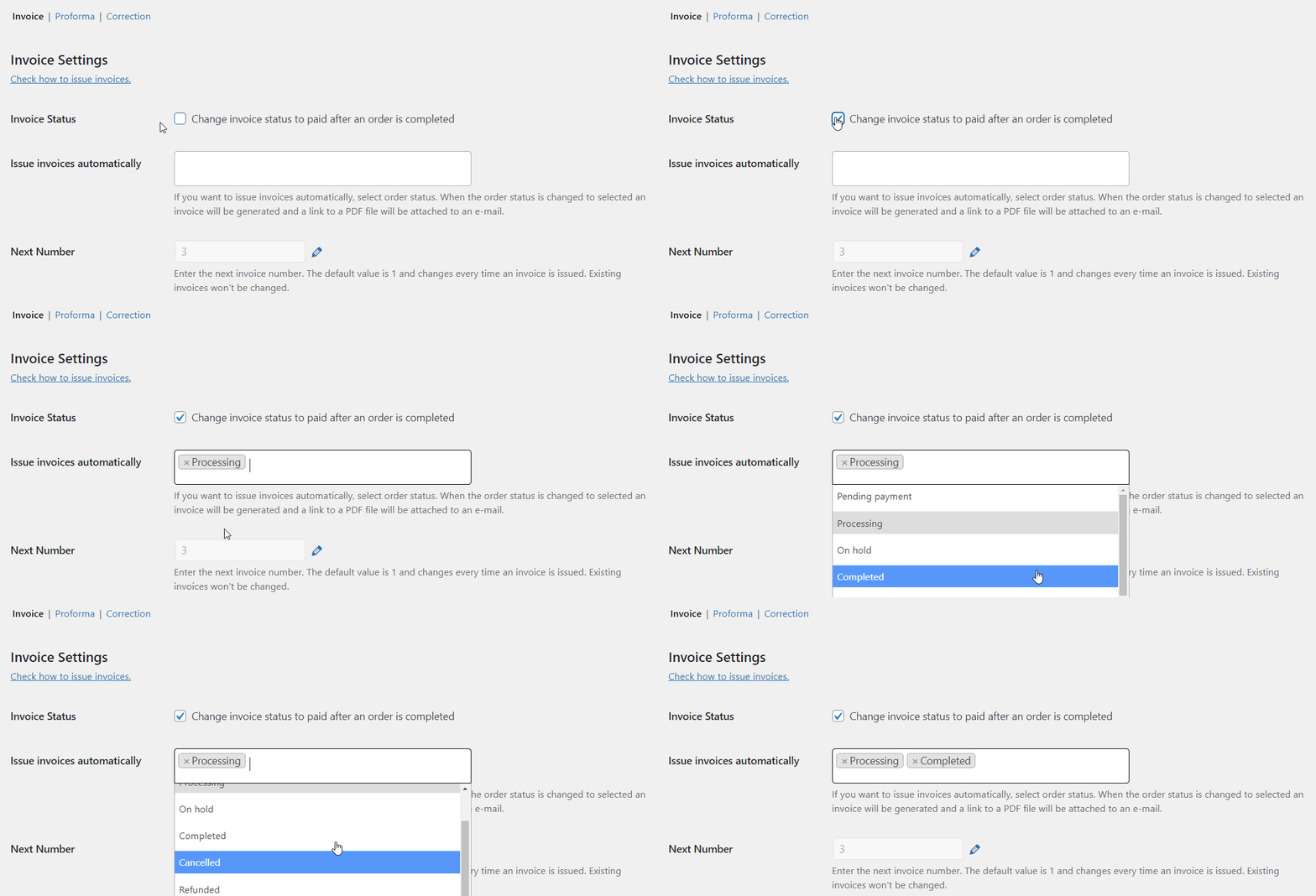
Processing is the usual choice, since that is the status an order reaches after a successful payment. Avoid the unpaid statuses, because every document consumes a number and abandoned orders would leave numbered documents for sales that never happened.
You may test the free and PRO versions of Flexible Invoices in a free demo.
Summary
WooCommerce sends an order email and nothing more, so a downloadable receipt comes from a plugin. In the free version the work is four settings and two clicks: company details, a Receipt prefix set before the first document goes out, then Issue Invoice and Send by e-mail on the order. PRO removes the two clicks by tying issuing to an order status, which is worth it once the volume makes manual issuing a daily chore. The prefix is a label, though, not a legal reclassification, so if your country treats fiscal receipts and invoices as separate documents, confirm which one you owe your customers before relying on this.
Questions before buying? Contact our support team and choose the Pre-sale Question option.
Frequently asked questions
Does WooCommerce generate receipts by default?
No. It sends an order confirmation email with no document number, no issue date and no seller details, and keeps no copy in the shop for either side to retrieve later.
Can I create WooCommerce receipts for free?
Yes. Issuing, viewing, downloading and emailing the document all work in the free version. Automatic issuing on an order status is the PRO feature.
Does renaming the document to Receipt change what it is?
No. It changes the name printed on an invoice. Where the law treats a fiscal receipt as a separate document, often one that must come from a registered cash register, this does not produce that document.
Can I change the prefix after issuing documents?
Yes, but the numbering keeps counting, so you end up with one sequence carrying two different names. Set the prefix before the first document.
Why does the plugin interface still say Invoice?
The prefix only affects document names. To change the wording in the admin screens as well, use a string replacement plugin such as Say What or a translation file.
What do the {DD}, {MM} and {YYYY} tags do?
They insert the day, month and year into the document name, which is how you add a dated suffix such as Receipt 1/03/2026.
Which order status should issue the document automatically?
Processing in most stores, because it follows a successful payment. Unpaid statuses would consume numbers for orders that may never be completed.
Does the receipt include VAT?
Yes, the plugin handles VAT and prints your VAT number when you have entered one in the settings.
