


WooCommerce has no invoice template to customize, because it does not issue invoices at all. What it produces is the order details view in My account and the order email. A real PDF invoice, and any control over how it looks, comes from a plugin. In Flexible Invoices the template is edited in a block editor: you add blocks to the document, upload a logo, decide which fields appear and rearrange the layout without touching PHP. That editor is part of the free version. This guide covers what you can change, what has to stay on the document whatever you do with it, and when to switch the editor off and use a predefined template instead.

Table of contents
- What WooCommerce gives you by default
- How to customize the invoice template
- Adding your logo and branding
- Which fields you can change
- Layout and readability
- Turning the editor off
- Is the customizer in the free version?
- Frequently asked questions
What WooCommerce gives you by default
The thing people call the “default WooCommerce invoice” is the order details screen. The customer sees it in My account after opening a specific order, and the same content goes out in the order email.


It is a summary of what was bought, not an invoice. There is no document number from a continuous series, no issue date separate from the sale date, no seller’s tax number and no PDF. Those are the things that make a document an invoice, and none of them exist in core WooCommerce.
That is also why there is nothing to customize at this level. Changing how the order details look means editing PHP templates or writing filters. A PDF invoice with a layout you control is a different object, created by a plugin.
How to customize the invoice template
After installing Flexible Invoices, go to Settings → Invoice Template. The template opens in a block editor, the same one you know from WordPress content, with blocks for the parts of a document.

You add and remove blocks, upload a logo, and decide which data appears, with no code involved. A signature line, the order ID, bank details: each is a block you place where you want it.
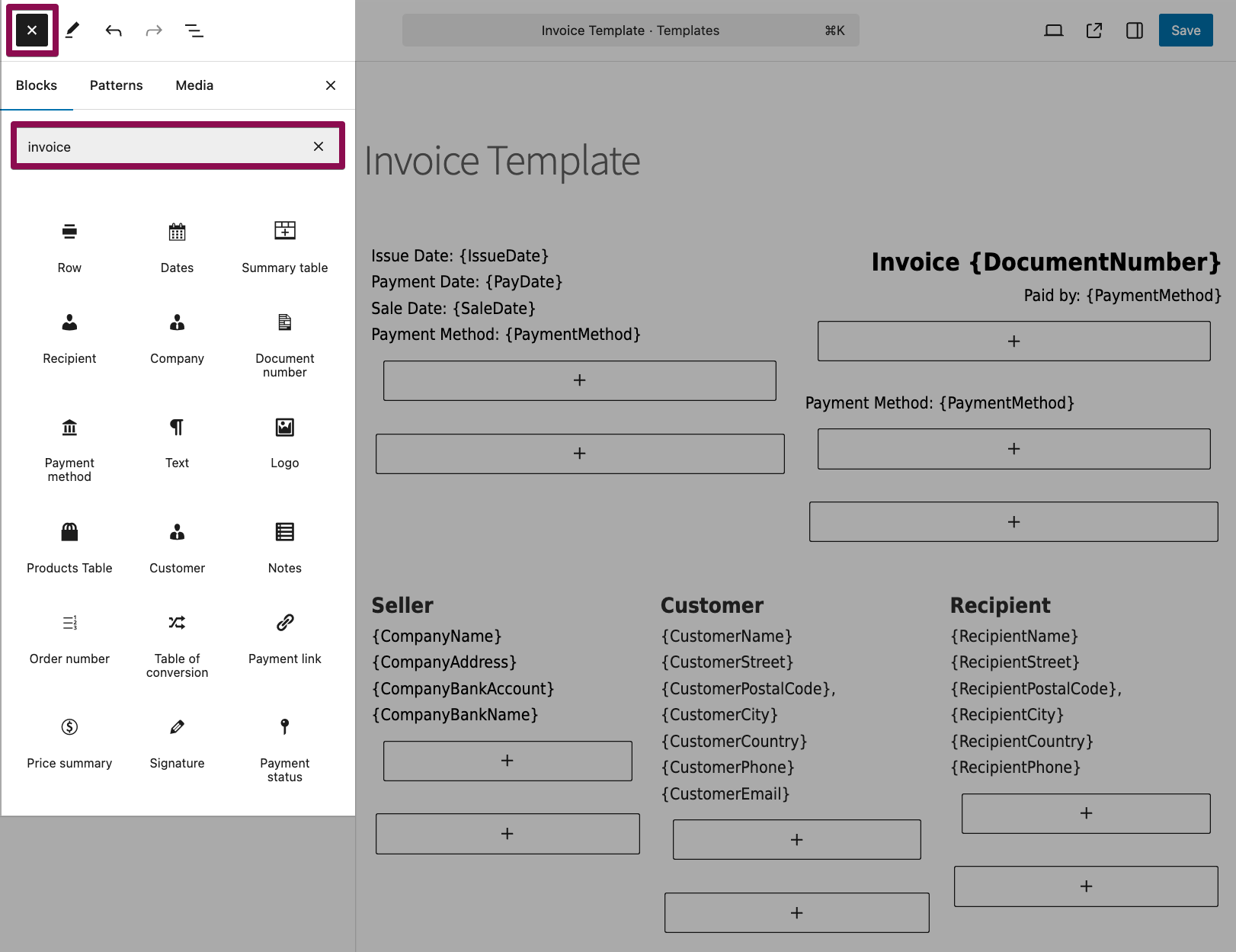
One habit worth forming from the start: after every change, issue a test invoice and open the PDF. The editor shows the template, not the rendered document, and the two can differ, especially with long company names, multi-line addresses and product tables that run to a second page. A layout that looks balanced in the editor can break on the first real order with nine items.

Adding your logo and branding
The logo is the change with the best ratio of effort to effect. Go to the Flexible Invoices settings and upload it in the branding section.

Then position and size it in the editor. Top left or top centre are the conventional places, and there is a reason for the convention: that is where an accounts payable clerk looks to identify who sent the document.
Upload the logo at roughly twice the size it will print. A PDF renders at higher resolution than a screen, so a small web logo that looks fine in the editor comes out soft on paper.
Other visual elements work the same way: a coloured rule, a PNG, a footer block.

Which fields you can change
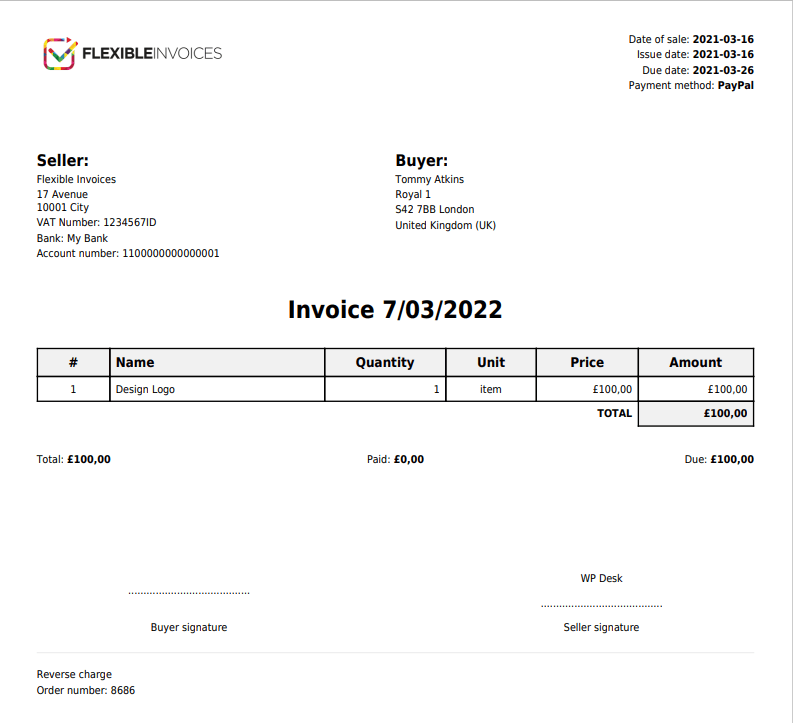
The template controls which data reaches the document: order details, shipping information, payment method, tax fields, discounts, SKUs, currency format and your own notes.

What should not be removed is the part that makes the document valid. The exact requirements differ by country, so your accountant is the authority, but the common core is the same almost everywhere: the document number, the issue date and the sale date, full details of both parties, the line items with their tax rates, and the totals split into net, tax and gross. Design around those rather than through them.
Two fields worth adding deliberately rather than by default. The seller’s tax number, because a document without it is not a VAT invoice in most of Europe. And payment terms with the due date, because an invoice that does not say when payment is expected gets paid when the buyer feels like it.
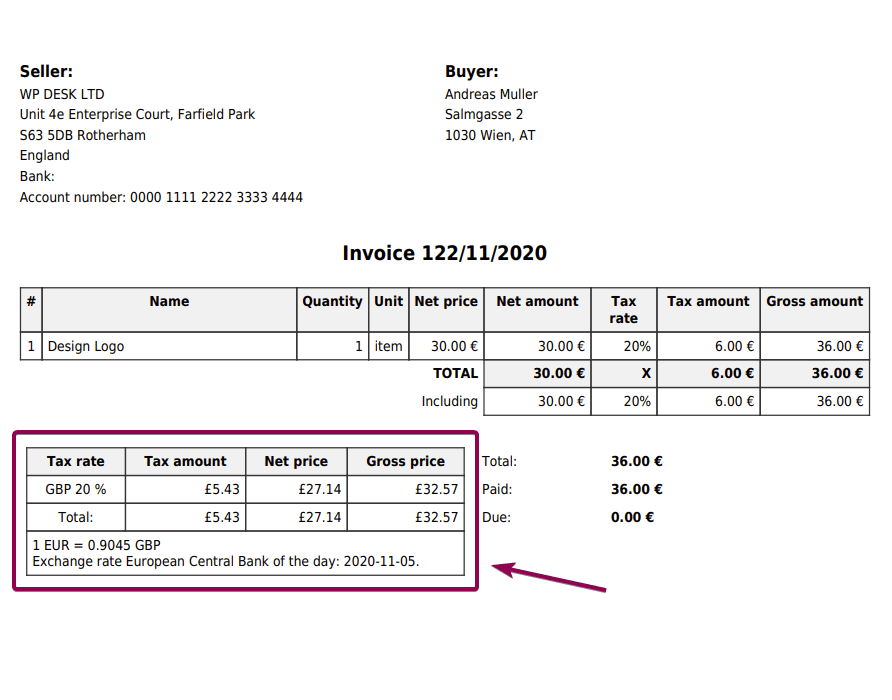
For VAT numbers on cross-border sales and currency conversion tables, see invoicing in the European Union with WooCommerce.
Layout and readability
Beyond branding, the layout decides how fast someone can act on the document. Two readers matter: the customer checking what they were charged, and whoever processes the payment.
Both look for the same three things first, and in the same order: the total, the due date, and where to send the money. If those three are not findable in two seconds, the layout is working against you no matter how good it looks.
Practical consequences: keep the total visually heavier than the line items, put payment details near it rather than in a footer nobody scrolls to, and move the tax breakdown out of the way if your customers are consumers who will never read it.
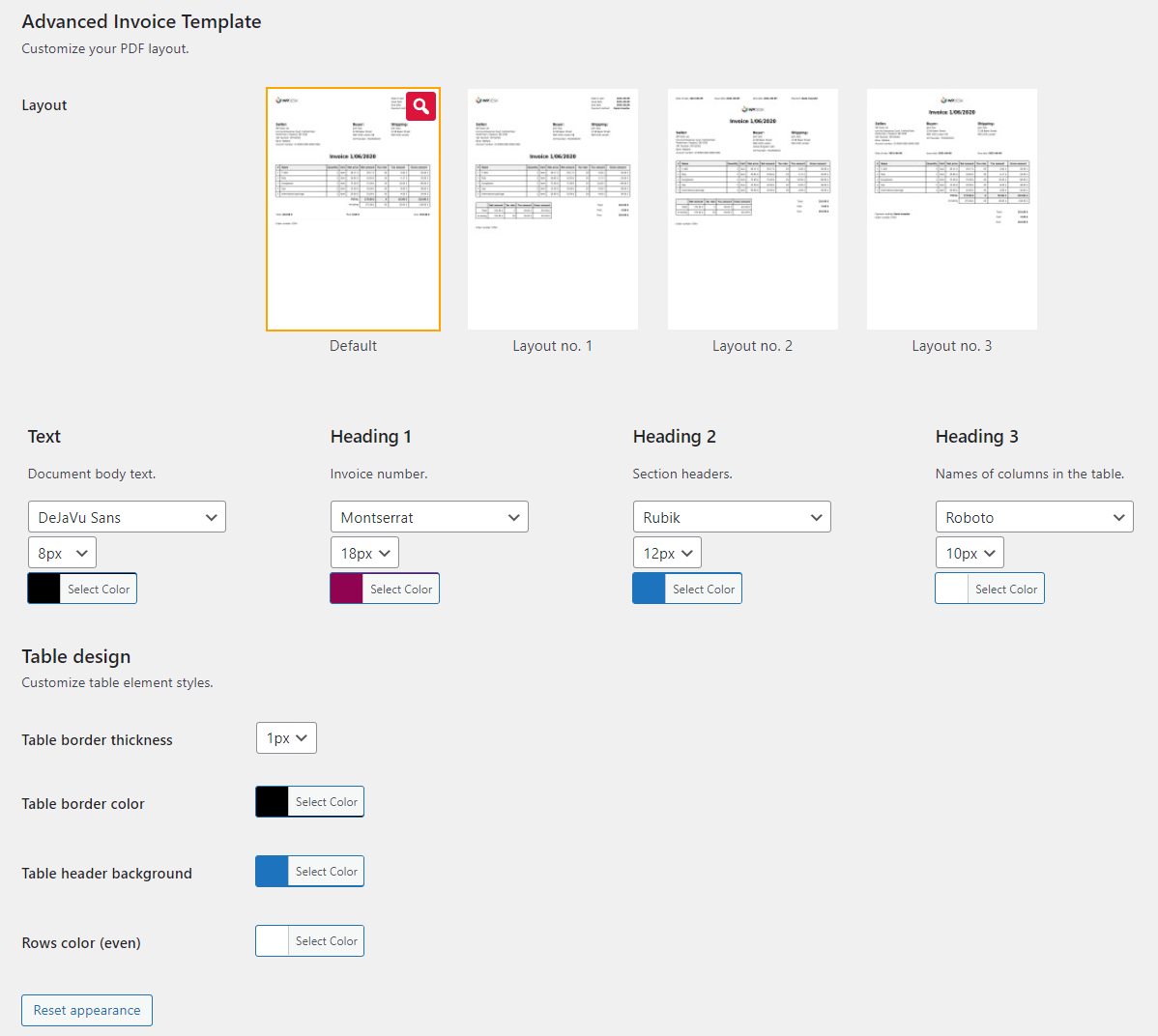
You can also adjust font size, style and colour to match your branding. Keep the body type large enough to survive printing and scanning, which is still how a lot of invoices travel.
Turning the editor off
The block editor is not compulsory. You can switch it off and use a predefined template instead, which is the better choice when nobody in the company wants to maintain a layout.

With the Advanced Templates add-on you get several templates and fuller control over colours, fonts and layout.
Is the invoice customizer available in the free version?
Yes. The template editor, the logo upload, the field selection and the layout changes are all in the free plugin, and so is PDF generation itself. You can issue branded, properly structured invoices without paying anything.
What PRO adds is not the design but the workflow around it: issuing documents automatically on an order status, proforma and correction documents, discounts and shipping on the document, and EU VAT validation with OSS and reverse charge. Advanced Templates, with multiple templates and finer control over colours and fonts, is a separate add-on.
Summary
WooCommerce does not have an invoice to customize, only order details, so the first step is a plugin that produces a real PDF. Once it is installed, the template opens in a block editor where the logo, the fields and the layout are yours to arrange, all of it in the free version. Design around the elements that make the document valid rather than through them, put the total, the due date and the payment details where they are found in two seconds, upload the logo at double the printed size, and generate a test invoice after every change, because the editor shows the template and the PDF shows the truth.
Automatically send and further customize PDF invoices with PRO
Frequently asked questions
Does WooCommerce have an invoice template?
No. WooCommerce produces order details in My account and in the order email, which is a summary of the purchase rather than an invoice. There is no document number, no PDF and no template to edit without a plugin.
Is the invoice customizer free?
Yes. The template editor, logo upload, field selection and layout changes are in the free version of Flexible Invoices, along with PDF generation. PRO adds automation, proforma and correction documents and EU VAT handling, not the design tools.
How do I add a logo to a WooCommerce invoice?
Upload it in the plugin’s branding settings, then size and place it in the template editor. Use an image about twice the printed size, because a PDF renders at a higher resolution than a screen.
Which fields can I remove from the invoice?
Technically most of them. In practice keep the document number, both dates, the details of both parties, the line items with their tax rates and the net, tax and gross totals, because those are what make the document valid. Requirements vary by country, so confirm with your accountant.
Why does the PDF look different from the editor?
The editor shows the template, not a rendered document. Long company names, multi-line addresses and tables that spill onto a second page change the result. Issue a test invoice after every change and open the PDF.
Can I use a ready-made template instead of designing one?
Yes. The block editor can be switched off in favour of a predefined template, which is the sensible choice if nobody will be maintaining the layout. The Advanced Templates add-on provides several templates and finer control.
Can I change fonts and colours on the invoice?
Basic font and colour adjustments are available in the editor. Full control over typography, colours and multiple layouts comes with the Advanced Templates add-on.
Do template changes apply to invoices already issued?
No. A document is generated at the moment it is issued, so an issued invoice keeps the template it was created with. Only new documents use the updated design.
