




Two different mechanisms handle cross-border VAT in the EU, and WooCommerce does not decide between them for you. Pick the wrong one and the invoice is wrong, which in practice means you either charged VAT you should not have, or did not charge VAT you owe.
Which one applies to a given order
The buyer decides, not the product and not the country.
Selling to a business in another EU country, with a valid VAT number: reverse charge. You do not charge VAT. The buyer accounts for it in their own country. The invoice must say so explicitly.
Selling to a consumer in another EU country: OSS. You charge the VAT rate of the customer’s country and declare it through the One Stop Shop instead of registering for VAT in each member state.
Selling to a consumer at home, or to a buyer without a valid VAT number: domestic VAT. A business customer who cannot produce a valid number is treated as a consumer for this purpose.
So the whole decision rests on two pieces of information you must have at checkout: where the customer is, and whether they have a valid VAT number.
What each one has to show on the invoice
A reverse charge invoice shows no VAT amount, carries both VAT identifiers, and states that the reverse charge procedure applies. Omitting that statement is the single most common defect, because the figures look right and nothing visibly fails.
An OSS invoice shows the destination country’s VAT rate and amount. Your own domestic rate does not appear anywhere on it.
The threshold that catches small stores out
OSS is not required from the first order. An EU-wide threshold applies to cross-border distance sales to consumers, and below it you may keep charging your domestic rate. Above it, destination VAT applies.
Two things make this trip people up. The threshold counts all qualifying cross-border B2C sales together, not per country. And once you cross it, the obligation starts immediately, not in the next tax year.
The figure and its exact scope are worth confirming with your accountant, because what counts towards it is narrower than most summaries suggest.
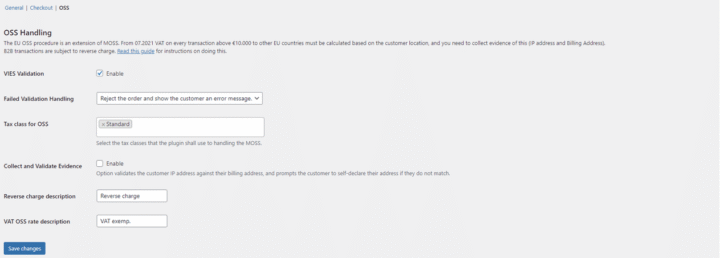
Why validation sits underneath all of this
Reverse charge depends on the buyer’s VAT number being valid. If it is not, the correct treatment was domestic VAT, and the amount you did not charge is yours to pay.
Checking the number at the moment of purchase, rather than when the accountant finds it, is the difference between a corrected order and an unexpected liability.
Both mechanisms depend on data captured before the invoice exists. Flexible Invoices handles OSS rates and reverse charge in WooCommerce, validates the buyer’s VAT number and puts the required statement on the document automatically.
Summary
Cross-border VAT in the EU runs on two mechanisms and the buyer decides which applies. A business in another member state with a valid VAT number means reverse charge: no VAT is charged, the buyer accounts for it, and the invoice must state the procedure explicitly. A consumer in another member state means OSS: you charge the destination country’s rate and declare it through the One Stop Shop. A consumer at home, or any buyer without a valid VAT number, means domestic VAT, because a business that cannot produce a valid number is treated as a consumer here.
The decision therefore rests entirely on two pieces of information captured at checkout: the customer’s location and the validity of their VAT number.
The documents differ. A reverse charge invoice shows no VAT amount, carries both VAT identifiers and states that reverse charge applies, and omitting that statement is the most common defect because the figures still look correct. An OSS invoice shows the destination rate and amount, with no trace of your domestic rate.
OSS is not mandatory from the first sale. An EU-wide threshold covers cross-border distance sales to consumers, counted across all countries together rather than per country, and crossing it triggers the obligation immediately rather than in the following tax year. Confirm the figure and its scope with your accountant.
Validation underpins both. If a buyer’s VAT number turns out to be invalid, the correct treatment was domestic VAT, and the amount you did not charge becomes your liability.
Frequently asked questions
These four separate the two mechanisms in practice.
Can one order be both reverse charge and OSS?
No. The two are mutually exclusive, because one applies to business buyers and the other to consumers.
What if the customer gives a VAT number after the order?
The invoice was issued on the information available at the time, so the usual route is a correction invoice rather than editing the original.
Does reverse charge apply outside the EU?
Sales to buyers outside the EU follow export rules, which are different again. Reverse charge as described here is an intra-EU mechanism.
Do I still need to register for OSS if I am below the threshold?
Not necessarily, but many stores register voluntarily so the treatment does not change mid-year when the threshold is crossed.
