




Structured invoicing changed what an invoice is, and most stores have not caught up with what that means for storage. The file you have to keep is no longer the PDF in your email folder, and the backup that covers your website may not cover it either.
What you have to keep, and for how long
The retention period is set nationally and commonly runs to several years after the end of the tax year in which the invoice was issued, which in practice means somewhere between five and eleven depending on the country. Your accountant knows your number; the part worth understanding is what the obligation applies to.
It applies to the invoice in the form it was issued. If you issued a structured file, that file is the invoice, and a PDF rendering of it is not the same as the original. Where both exist, as in most setups sending a structured document alongside a readable copy, both are worth keeping, and the structured one is legally the document.
Three properties are usually required of that storage: the document must stay readable for the whole period, it must not be alterable after the fact, and you have to be able to find a specific one when asked. The third is the one stores fail most often, because an archive nobody can search is only technically an archive.
Why the website backup is not an archive
A hosting backup exists to restore a broken site. It is usually rotated, so a backup from three years ago no longer exists, and it is stored in a format that requires restoring the whole site to read one file.
Neither property suits an obligation measured in years. An archive is a separate thing: a copy of the documents themselves, held off the server running the store, readable without reconstructing a website.
The same applies to the database. Documents held only inside a WordPress installation are hostage to it, and migrations, plugin changes and a lapsed licence are all ordinary events.
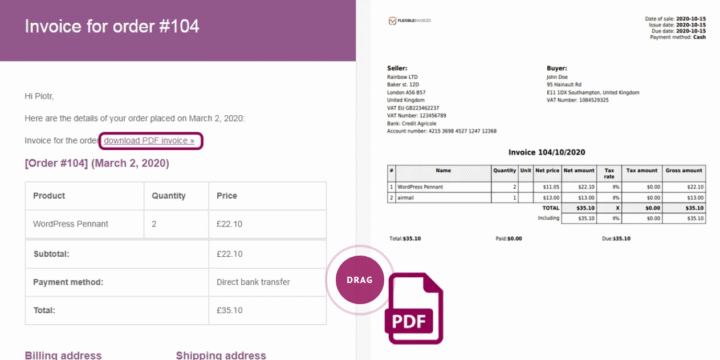
A storage routine that survives a migration
Export at a fixed interval rather than at the end. A monthly or quarterly export held outside the site keeps the archive current, and no single export is ever large enough to be postponed.
Keep both formats where you issue both. The structured file satisfies the obligation and the PDF is what a person reads, including you, in three years, when the question is what a particular order actually contained.
And store the period reports beside the documents. A list of what was issued is how you later prove the archive is complete, which is a question nobody asks until it matters.
An archive is only as good as your ability to pull one document out of it. Flexible Invoices keeps invoices, corrections and proformas as separate document types with their own numbering, and exports a date range in one operation, which is what makes a periodic export a routine rather than a project.
Summary
Retention periods are set nationally and typically run several years from the end of the tax year of issue, commonly between five and eleven. The period is a question for your accountant; what matters here is the scope of the obligation.
It covers the invoice in the form it was issued. A structured file is the invoice and a PDF rendering is not a substitute. Where both are issued, both are worth keeping and the structured one is the legal document. Storage normally has to keep documents readable for the whole period, unalterable after issue and findable on request, and the last is where stores fail.
A hosting backup does not satisfy this. Backups rotate, so one from three years ago no longer exists, and they store the site rather than the documents, so reading one invoice means restoring everything. The same applies to documents held only inside WordPress, since migrations, plugin changes and a lapsed licence are ordinary events that should not be able to take an archive with them.
A routine that survives all of it: export every document issued in a period at a fixed monthly or quarterly interval and keep the copy off the server, keep both the structured file and the PDF where both are issued, and store the period reports alongside, because the list is how completeness is demonstrated later.
Frequently asked questions
These four come up once a store starts issuing structured documents.
Is keeping the PDF enough?
Not if the structured file was the document you issued. Keep both, and treat the structured file as the one the obligation covers.
Can I store invoices in cloud storage?
Generally yes, and most countries allow storage abroad with conditions attached. Confirm the conditions for your country rather than assuming, because this is one of the places national rules differ.
Do proformas need to be kept?
They are not accounting documents, so the retention obligation does not reach them in the same way. Keeping them is still useful when a customer disputes what was agreed.
What happens if I stop using the plugin?
That is the scenario the archive exists for. If your only copy lives inside the installation, deactivating or migrating puts it at risk, which is the argument for exporting on a schedule rather than on exit.
