




Since 1 September 2026 every business established in France and registered for French VAT must be able to receive structured e-invoices. Large and mid-sized companies must also issue them from that date. SMEs and micro-businesses have until 1 September 2027 to start issuing, but the receiving obligation already applies to them. Invoices travel through accredited providers, not by email, and the usual formats are Factur-X and UBL. If you run a WooCommerce store in France and sell to other businesses, this is what changed and what to do about it.
Who is in scope
The rules apply to domestic B2B transactions between businesses established in France and liable for French VAT. Sales to consumers are outside the mandate, and so are cross-border sales, which stay under normal VAT rules until EU-wide reporting arrives in 2030.
Two dates matter:
- 1 September 2026. Everyone must be able to receive. Large and intermediate-sized companies must issue.
- 1 September 2027. SMEs and micro-businesses must issue as well.
Receiving is the part most small stores overlook. You may not have to issue structured invoices until next September, but your suppliers already send them, and you need somewhere for those invoices to arrive.
How invoices actually move
France did not build a single government inbox. Invoices are exchanged through accredited service providers, and a public directory routes each invoice to the recipient’s provider. In practice that means three decisions for your store.
Choose a provider. You need an accredited partner that can receive and, when your phase starts, issue on your behalf. Your accounting software or your accountant may already work with one.
Register your identifiers. Your SIREN number identifies you in the directory. Get it right once and routing works; get it wrong and invoices bounce.
Decide where invoices are created. Either your store issues the invoice and hands it to the provider, or your accounting system does it from order data. Mixing both without a rule is how duplicate numbering starts.
What this means inside WooCommerce
Your checkout and your invoices need data that a PDF never had to carry.
- SIREN or SIRET and VAT number for business customers, collected at checkout, not typed later by hand.
- A clean company name and address, split into fields rather than one free-text line.
- Correct VAT treatment for exempt sales, reverse charge and zero rates, each with the reason attached.
- Payment terms and due dates, which structured formats treat as separate fields.
- Numbering without gaps, because rejected and resent invoices make gaps visible.
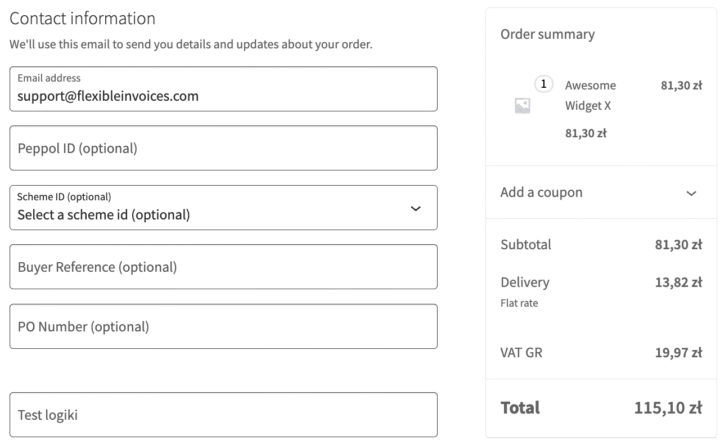
Flexible Invoices covers this layer: it issues invoices and corrections from orders, validates EU VAT numbers in VIES, and keeps numbering sequential. For the structured file, the PEPPOL for Flexible Invoices PRO add-on produces UBL (XML) invoices in the Peppol standard, which you download from the invoice edit screen. Sending them through an accredited French provider is the next step, and your provider will tell you which format they accept.
Preparing for your French deadline? Start with Flexible Invoices PRO for correct invoice data, then add PEPPOL for UBL output. EUR 59 a year for one site, or EUR 99 a year for the bundle with every add-on.
A practical order of work
- Confirm your phase: do you issue from September 2026 or September 2027?
- Ask your accountant which provider they already use.
- Add VAT and company number fields to checkout, and mark B2B orders.
- Check that invoice data is complete on ten recent B2B orders, picked at random.
- Test receiving first, because that obligation is already live.
- Plan issuing tests at least two months before your own deadline.
FAQ
- Do I have to issue e-invoices right now? Only if you are a large or mid-sized company. Smaller businesses issue from 1 September 2027, but must be able to receive since 1 September 2026.
- Does this cover sales to consumers? No. B2C sales are outside the mandate.
- What about customers in other EU countries? Cross-border sales are not covered by the French mandate. They come under EU-wide rules in 2030.
- What is Factur-X? A hybrid format: a PDF with structured XML embedded inside it, so people and machines read the same invoice. It is one of the accepted French formats, alongside UBL.
- Can I keep emailing PDFs to business customers? As a courtesy copy, yes. As the legal invoice in scope of the mandate, no.
- Do I need a French provider if my store is outside France? The obligation follows businesses established in France. If you are established elsewhere, you follow your own country’s rules, but your French customers may still ask you to send invoices their way.
