




Belgium is no longer preparing for structured e-invoicing. The domestic B2B obligation came into force on 1 January 2026, which means a WooCommerce store selling to Belgian businesses is either compliant now or already issuing documents that do not meet the law.
What the Belgian e-invoicing mandate actually requires
Every VAT-registered business established in Belgium must issue and receive structured electronic invoices for domestic B2B transactions. Structured means a machine-readable data file, by default Peppol BIS, exchanged over the Peppol network. A PDF sent by email does not satisfy the obligation.
Three boundaries decide whether this touches your store at all.
- B2C is outside the scope. If you sell only to consumers in Belgium, nothing changes for you.
- It is domestic. The obligation covers transactions between businesses established in Belgium. Cross-border invoicing follows the rules of the countries involved, not this mandate.
- Receiving counts too. Even businesses that rarely issue B2B invoices have to be able to accept one, which in practice means being reachable on the Peppol network.
So the first question is not which plugin to install, but whether you have Belgian business customers at all.
What this means for a WooCommerce store in practice
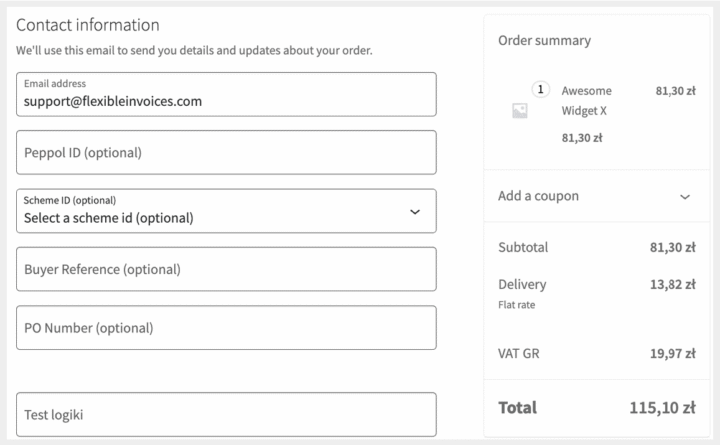
If you sell to Belgian companies, your store needs three things that a standard WooCommerce setup does not provide on its own.
A VAT number collected at checkout. Without it you cannot tell a business order from a consumer order, and the invoice has to be issued differently in each case.
An invoice generated as structured data, not only as a PDF. The document has to carry the required fields in a defined format, which is where the Peppol add-on does the work.
A way to send it over the Peppol network. Peppol uses a four corner model: you connect to an access point, your customer connects to theirs, and the two exchange the document.
Peppol BIS and what makes it the default
Belgium did not invent a national format. It pointed at Peppol BIS, a usage specification built on the European standard EN 16931, and that choice has a practical consequence.
A store that can produce a Peppol BIS invoice for Belgium is most of the way towards the requirements appearing in other member states, because they are drawing on the same standard. The work is not Belgium-specific, even though the deadline is.
What to do if you are not ready
The deadline has passed, so the sequence is about catching up, not planning.
Start with your order data: pull Belgian B2B orders from the last six months and see how many carry a valid VAT number. That tells you the size of the problem.
Fix collection at checkout before anything else, because an invoice cannot be built from data you never captured. Only then does connecting to Peppol make sense.
If you already issue invoices from WooCommerce, the structured format is an add-on, not a migration. PEPPOL for Flexible Invoices generates Peppol standard documents from the orders you already have, so the numbering, templates and sending rules you set up stay as they are.
Summary
Belgium made structured electronic invoicing mandatory for domestic B2B transactions from 1 January 2026, so the obligation is already in force. Structured means a machine-readable data file exchanged over the Peppol network, with Peppol BIS as the default, and a PDF sent by email does not meet the requirement.
The scope is narrower than it first sounds. Sales to consumers are excluded, the mandate covers transactions between businesses established in Belgium rather than cross-border trade, and the duty to receive applies even to companies that issue few B2B invoices themselves.
A store selling to Belgian companies needs three things a default WooCommerce installation lacks: a VAT number captured at checkout, invoices produced as structured data rather than only as PDFs, and a connection to a Peppol access point.
Peppol BIS is a usage specification of the European standard EN 16931, so the work done for Belgium carries over to other member states. Catching up starts with the order data: count how many Belgian B2B orders from the last six months hold a valid VAT number, fix collection at checkout, then connect to Peppol.
Frequently asked questions
Four questions come up most often from stores that discovered the Belgian mandate after it started.
Does the Belgian mandate apply to my store if I am based elsewhere in the EU?
The obligation is on businesses established in Belgium for their domestic transactions. If you are established elsewhere, your Belgian customers may still ask you to send structured invoices, but the legal duty falls on a different party. Check with your accountant rather than assuming either way.
Can I keep sending PDF invoices as well?
Yes, and most stores do. The structured file satisfies the obligation, while the PDF remains the version a human reads. They are not alternatives.
What happens to invoices for Belgian consumers?
Nothing. B2C is outside the scope of the mandate, so those documents continue exactly as before.
Do I need my own Peppol access point?
No. Stores connect through a service provider rather than operating an access point themselves.
